A First Visit to a Community Festival: Making Time to Notice
A first visit to a community festival is easier when you know the sequence, watch before joining in and leave room to notice what matters to participants.
At an unfamiliar community festival, the first useful move is to pause near the entrance and watch where people go. A first visit to a community festival becomes more thoughtful when you learn its basic sequence before joining in, then notice how participants use each part.
Check the invitation
Start with the festival’s own programme, website or noticeboard. Look for practical details: opening times, locations, entry arrangements, accessibility information, food guidance and any instructions for visitors. A programme may list events in order, but it may not explain which moments are intended for everyone and which are mainly for participants.
If the event is hosted by a community organisation, read its visitor guidance rather than relying on an old social media post. Check whether photography is restricted, whether particular areas are private, and whether donations or registration are requested. Where instructions depend on the organisers’ rules or local requirements, follow the posted guidance or ask an organiser.
Choose one clear question to resolve before you arrive. For example: “Where should a visitor stand during the opening?” A concise, respectful question is easier for a busy volunteer to answer than a request for a full explanation of the tradition.
Learn the sequence
Sketch the event in broad strokes from the information available: arrival, welcome, central activity, shared pause, procession or performance, and closing, if those parts are listed. Do not assume every festival follows this pattern. Your aim is simply to recognise transitions, not to predict every detail.
Mark one or two moments you especially want to understand, and leave the rest open. A printed programme can help you follow locations; a note on your phone can hold times or questions. Keep the screen away once the event begins, so you can attend to the people and sounds around you.
Plan a flexible arrival. Coming with enough time to find the entrance and orient yourself reduces the pressure to copy others immediately. If the site is busy, step aside rather than stopping in a doorway or blocking a route.
Arrive and orient
At the entrance, notice how people are being received. Is there a welcome table, a queue, a greeting from volunteers, or an open space where visitors can gather? Follow the clearest public cues, and ask an organiser if you cannot tell where guests should go.
Take in the layout before choosing a place to stand. Look for marked paths, seating, signs, and areas that appear reserved for performers or community members. If you need a quieter position, choose one that still leaves room for people moving through the event.
Say hello simply. “I’m visiting for the first time; is there a good place to watch?” gives a host useful context without putting them on the spot to explain everything. If they are occupied, accept a brief direction and let them return to their work.
Watch before joining
For the first activity, observe the shape of participation. Notice who begins, how others respond, whether there are spoken cues, and what visitors appear welcome to do. Pay attention to pauses as well as action: a quiet interval may be part of the event, not a gap to fill.
Watch how people handle objects, move through shared space and respond to music or announcements. Keep a respectful distance from anything that seems ceremonial or personal. Do not imitate a gesture simply because it looks easy; wait for an invitation or a clear public cue.
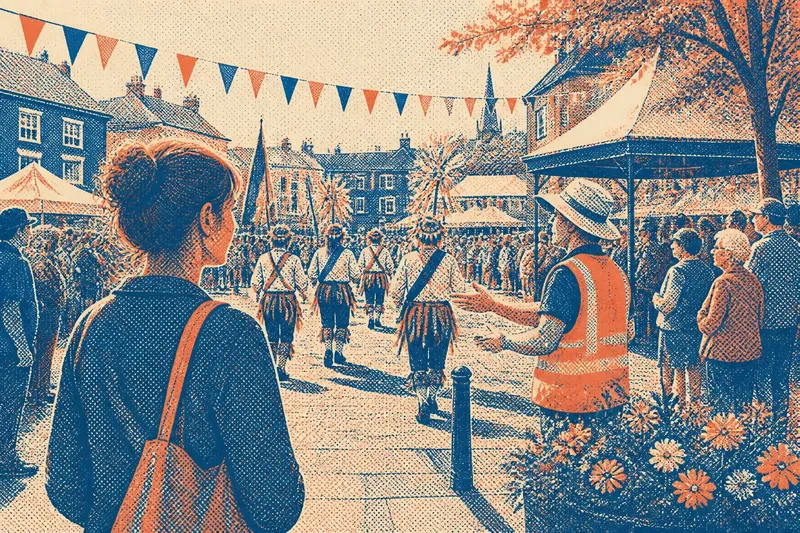
Imagine you arrive as a community procession gathers in a square. You stand at the edge, notice that people leave a central lane clear, and ask a steward whether visitors should follow or remain in place. If the steward points you to the viewing area, you can watch without interrupting the route and join a later public activity if invited.
Join with care
When an activity is clearly open to visitors, take part at the level you understand. Follow the group’s pace, use materials as shown, and allow others room. If you miss a cue, wait for the next one rather than drawing attention to yourself by improvising.
Some activities are open to all; others may have roles or meanings that are not obvious to a newcomer. There is no need to prove your interest by joining every part. Watching quietly can be a considerate form of attendance, especially when the event includes a private, sacred or community-specific moment.
Keep conversation and photography in proportion to the setting. A quick greeting may be welcome during a social interval, while a performance or procession calls for attention. Ask before taking close-up photographs of people, and put the camera away if anyone indicates discomfort.
Notice what matters?
How can I follow a programme?
Use it as a route map, not a script. Times and locations help you orient yourself, while the live event may shift or pause for reasons the printed schedule cannot explain.
What if I do not know a custom?
Wait, observe, and ask a host or steward at a suitable moment. A brief question about what visitors should do is usually more helpful than asking someone to speak for an entire community.
Should I take photographs?
Check signs and organiser guidance first, then consider whether a photograph would intrude on a person or a meaningful moment. When unsure, enjoy the scene without recording it.
How do I know when to leave?
Look for a closing announcement, a final shared activity or a clear shift as people begin departing. If you must leave earlier, do so quietly by an accessible route and avoid crossing the centre of an ongoing event.
Reflect after leaving
Once you are away from the crowd, write down what you observed while it is fresh. Separate what you saw from what you think it meant. “People turned towards the musicians after the bell” is an observation; “the bell called everyone to attention” is an interpretation to check.
Consider the sequence you followed: what signalled a change, who guided newcomers, and which moments seemed designed for shared participation? These questions help you notice how the festival works without treating one visit as a complete account of its meaning.
If a host explained something, record the point in your own words and note any uncertainty. Do not turn a passing comment into a universal rule about the community. If you plan to write or speak about the event, ask permission before sharing identifiable stories or images.
A first visit to a community festival is most rewarding when attention lasts beyond the central performance. Notice how people welcome one another, make room, and signal when an activity begins or ends. Those small cues can help you return with better questions and a more considerate sense of where to stand.